
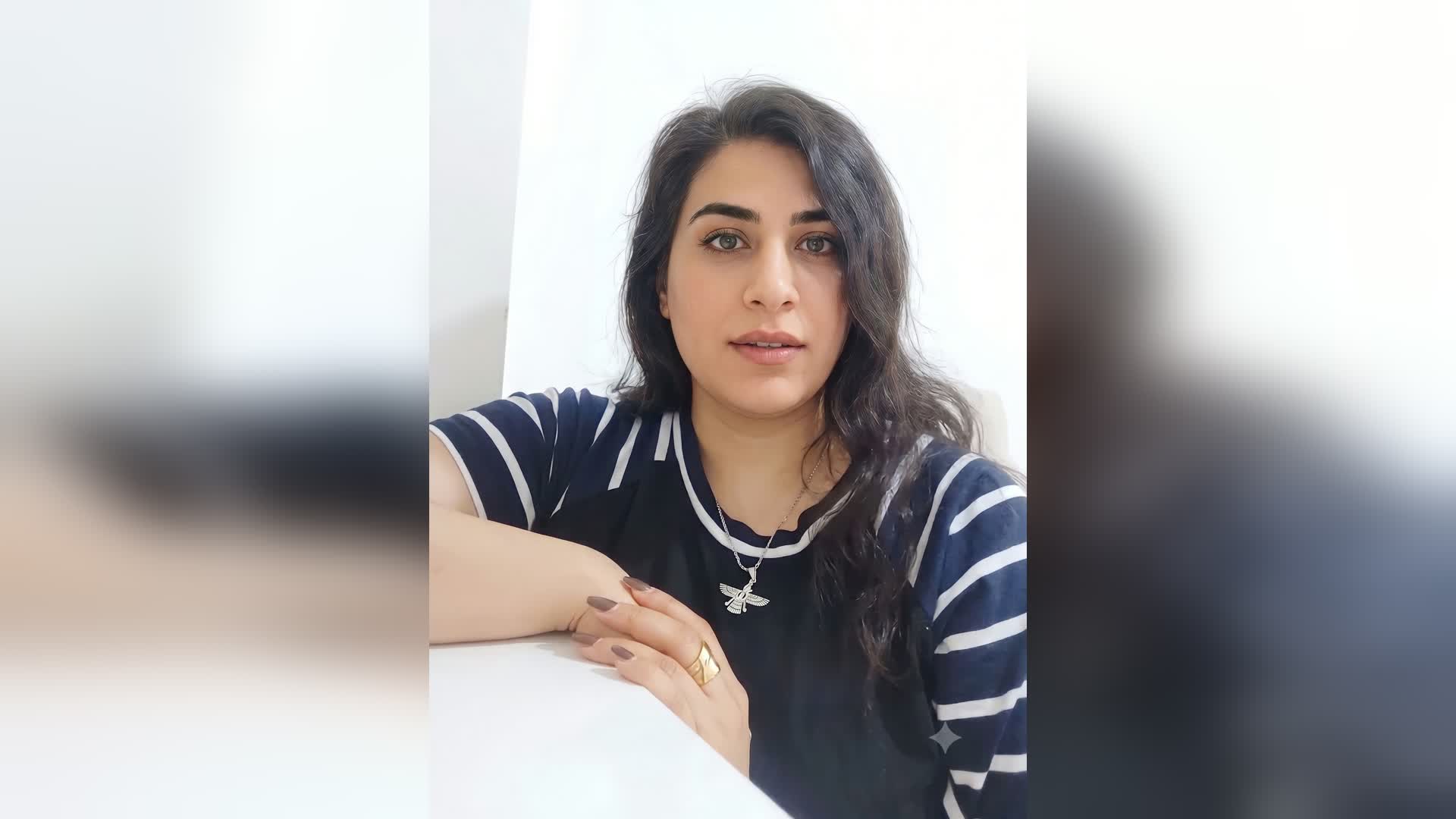
Mahboubeh Rezaei, Monarchist Political Prisoner, Emphasizes the Necessity of National Unity
Mahboubeh Rezaei, a political prisoner, in a message from Evin Prison emphasized the necessity of national unity, describing the Islamic Republic’s war-mongering policies as the “primary cause of destruction and war.” She said: “A wise and united nation never fails, and the light of freedom will triumph over the darkness of tyranny.”
Mahboubeh Rezaei wrote in this message: “Addressing all those who claim compassion today and speak of human lives and infrastructure, I—a daughter of Iran, a child of Rais Ali Delvari from the proud south of this land, from the home of steadfast palm trees and the eternal Persian Gulf—write to you from behind the walls of Evin Prison. A simple yet fundamental question occupies my mind; a question rooted in my principles of struggle: Is freedom and individual dignity possible without national identity and the rule of law?”
Regarding individuals and groups who once labeled nationalists and patriots as ‘fascists and chauvinists’ for their love of Iran and claimed that ‘the land does not matter, people do,’ yet now display contradictory behavior, she said: “Today the words have been reversed: those same people now call us stateless and traitors. This blatant contradiction is not a sign of sincerity, but a revelation of your political opportunism.
We do not glorify war. But we consider the primary cause of destruction and war to be the war-mongering policies of the Islamic Republic; a government that for decades beat the drum of ‘Death to…,’ built proxy forces, spent the country’s resources on regional adventurism, and ultimately brought war onto Iranian soil. For years, the people of Iran have been engaged in an unequal war with this occupying, anti-Iranian regime.”
This monarchist political prisoner emphasized: “During the uprising of 18 and 19 Dey 1404, the largest massacre in contemporary Iranian history took place, and many of those same human rights claimants and civil activists remained silent. Executions continue daily, yet today they suddenly speak of ‘the country’s infrastructure.’ Our question is: infrastructure for what? Are buildings and pipelines more valuable than the lives of free citizens? For years, without any external war, Iran’s natural resources and infrastructure have been plundered, national wealth funneled into military-mafia institutions and proxy forces, and the people of southern Iran—whose share of oil and gas should have brought prosperity—have received only dust storms, cancer, water and electricity outages in 50-degree heat, and discriminatory university entrance quotas. Those who today chant slogans about ‘southern Iran’ once prioritized southern Lebanon. When Rajaee Port burned and hundreds of our compatriots lost their lives, why were you silent? Because the victims were Persian-speaking and did not fit an ‘ethnic’ narrative? This selective empathy stands in complete contradiction to the universal principles of human rights upon which liberalism relies.”
Recalling that “Mansoureh Heydari and Behrouz Mansouri, my fellow citizens in Bushehr, were shot dead by domestic repressive forces. They came to the streets for bread, freedom, and human dignity,” she addressed “opponents of the Pahlavi” and said that “ignoring the will of more than 50 percent of a society that is inclined toward constitutional monarchy and the Pahlavi,” and “attacking and insulting the Pahlavi and its supporters means ignoring the history of this regime’s crimes: hundreds of political prisoners—including a child prisoner in Evin—thousands of executions from March 1979 to today, and repeated street massacres.”
Mahboubeh Rezaei added: “If you truly believe in democracy and the rule of law, you must respect the right to choose one’s beliefs. Iran’s future must be determined through a free referendum and the ballot box, not through the imposition of a minority ideology. Set aside Pahlavi-hatred; it only creates division and serves the enemies of Iran.”
This political prisoner also stated: “To emotional nationalists who sometimes act irrationally, I remind you: direct your finger of accusation straight at the Islamic Republic. The continuation of this regime is more dangerous for Iran than any transition scenario. Prince Reza Pahlavi, as in the past, can serve as a symbol of national cohesion and a bridge toward a secular, democratic, and prosperous Iran; a country in which individual rights, a free economy, the rule of law, and Iranian national identity stand side by side.”
Mahboubeh Rezaei further said: “The time has come to heal the wounded pieces of Iran’s body. Let us not allow foreign enemies or internal dividers to break our unity. A wise and united nation never fails. The light of freedom will overcome the darkness of tyranny. Long live Iran, long live free Iranians.”